Guggenheim Venice

Friday, December 10, 2010

Did you ever see that movie Dogma?

If you did, you'll remember that if Matt Damon and Ben Affleck's Loki and Bartleby manage to pass through the gates of that church and have their sins forgiven it will undermine the word of God and thus end all existance.

Fast forward from 1999's Dogma to 2003's the author (I mean actually the author, me) deciding where to go on her high school exchange. I thought Italy. I'd really like to go to Italy. But because my sister had such a good time with her family in Spain I decided to go to them. The rest is a very good story for another time, but the relevent bit for this story is that I figured I'd visit Italy while I in Europe anyway.

Well, I didn't.

And not only did I not go, but everyone else on the planet seemed to go to Italy over the next five years, whether they wanted to or not. I never seemed to make it, something would come up: someone's birthday, a visit to a friend. Anyway, I began to think that should I ever had made it through the arches of that Italian immigration office, wherever it was, I would open a black hole that would end all existance. And guess what? I did.

It seems like such a long time ago (a week) and I really want to forget it ever happened. The short of it was that I had a really, really hard time getting to Venice. Here's the long:

As you probably know, I had been living in Edinburgh. I was leaving on the Monday, and it started to snow on the previous Friday. No big surprise there. It's winter. Comes every year. You can set your really slow watch to it. Got to the airport and it's closed. Meaning no flights leaving (see previous post).

Next day, I wise up and ring British Airways in the morning. Flight still on? Yes. That's weird, the website says the airport is closed. Still on? Yes. Ok, I'm going in then. Ok? Ok.

Flight cancelled. Get me on a bus to Glasgow, and a flight NOT through London. One outta two ain't bad, and the bus is leaving now. Get to Glasgow, check into flight. Get boarding pass. Get a VERY intimate pat down. Get to gate. Wait. 2 hours. Flight seems to have disappeared from the monitors with no explanation or announcement whatsoever. What's that you say? CANCELLED?! Well I never...

No more flights for the rest of the day. 8:55 tomorrow morning? I'll take it. At this point I was really looking forward to having a go at someone, but there were so many other people that looked like they had many years experience having go's at people I figured I'd leave it to the professionals. I laughed a bit with the lady at the desk and told her she was doing a great job.

Airbus to town. Sleep. Airbus back to airport. Aaaaaaaand you can guess what happens next.

Back in the queue. Got talking to a very large man with a Tintin haircut in front of me who had come to Glasgow to be on The Weakest Link. We discussed the perils of missing orientation days - people have time to make alliances and you become the latecomer, an outsider. Training day for this job in Italy, you ask? That was yesterday morning...

I'll speed it up because this is becoming unbelievable (it was). Got on a flight to Heathrow. Flight delayed.


Because of said delay, I had to sprint to the next gate to catch my flight to Milan. You may have noticed that I was not originally going to Milan but Venice. The previous two sentences will be important later.

Arrive in Milan and go to get my bag. No bag. Turns out the baggage handlers in Heathrow are not so nimble as I. Bus to Milan Central Train Station to go to Venice BUT because I wasted time not collecting my bag, I had missed the last train to Venice. Hotel. Dinner. Sleep.

SIX A.M. TRAIN TO VENICE. Get on the vaporetto. Meet my wonderful landlord. Venice is eerie, but pretty. Boats everywhere. No cars.

It's starting to be OK.

Monday, November 29, 2010

Let me just say something...

Flight cancellation allows time for, among other things (mulled wine, laundry, showers), reflection on huge opportunities. Like, say, a Peggy Guggenheim Internship.

It was about 2 years ago now that I first heard about these internships. One of those selected had given a guest lecture in a class of mine (a great lecture) and the other had been an (equally great) tutor of mine. Never, I thought. So waiting at the airport this morning, flight cancellation aside, was... surreal (har har). I'm nervous. And more than anything I'm thinking about my Masters next year, and how this makes me feel like a proper scholar.

And I've never been to Italy. So that's pretty cool.

I'm kind of a big deal.


Maybe.


'Of course, there are basic correspondences [with the art of the past] in so far as the plastic arts are plastic - that is to say, concerned with the manipulation of form and colour. In this sense, art has always been abstract and symbolic, appealing to human sensibility by its organization of visual and tactile sensations. But the vital difference consists in whether the artist in order to agitate the human sensibility proceeds from perception to representation; or whether he [sic] proceeds from perception to imagination, breaking down the perceptual images in order to re-combine them in a non-representational (rational or conceptual) structure. This conceptual structure must still appeal to human sensibility, but the assumption is that it does this more directly, more intensely, and more profoundly in this new way than if burdened with an irrelevant representational function. On one side of this watershed in the history of art it may be argued that since natural forms realized in conventional space reinforce the artist's appeal to human sensibility; on the other side it may be argued that since natural forms introduce a criterion of accurate presentation that is subject to an intellectual judgment, the spectator is likely to be affected more powerfully through images that can be freely organized to appeal directly to human sensibility.'

Sir Herbert Read. A Concise History of Modern Painting. London: Thames and Hudson, 1959.

PSYCH

One of Antony Gormley's Stockbridge Men weathering the silent storm


Well, that didn't go quite as planned.

Early snow in Edinburgh has closed the airport this morning. That's what the newspapers would have you believe. I do not deny that it is shut - I was there this morning. But it turns out it had been since yesterday afternoon. We were informed not by the AirLink people, who let us pay our £6 to get there and back, but rather by the nice lady with the big clipboard with the bit of paper reading 'ALL FLIGHTS CANCELLED.'

Long story short, flight is cancelled, re-booked for same time tomorrow, and I was sent home to make macaroni & cheese and have a nap.

If a frog had wings it wouldn't bump its ass when it hopped. And - it would take the train.


Sunday, November 28, 2010

The Final Countdown

Every blog needs an entry with this title.

T-minus not very long at all. 10 hours maybe? I shouldn't count or I'll get nervous.

So I have a flat (which I haven't even seen photos of), a mobile number to contact, and €7 cash. So if I manage to post another post in the next couple of days, I have survived.

Managed a good half of A Concise History of Modern Painting but that must be returned to Glasgow University Library.

Oh, and I almost forgot to mention. My blessed MacBook, which was going to be left to my sister, couldn't bear the thought of living without me a single day and kicked up a tremendous fuss on Thanksgiving morning. We took it to the shop, they had a look, and rang us that evening with the diagnosis. Died of a broken heart.

And it took my Guggenheim Interns' Powerpoint presentation with it.

What doesn't kill us, right?

Right.

Friday, November 19, 2010

Art Is Long and Life Is Short


'[...] artists enter their ideas into the world, not just into books and art history classes.'

And it's a good thing, too.

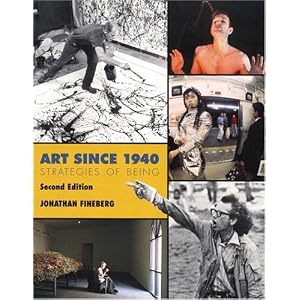
OMIGOD. So, after about three weeks I have managed to close the cover on Jonathan Fineburg's glorious Art Since 1940: Strategies of Being. I hadn't actually paid much attention to the sub-title until just now when I typed it out, but I like it. It is a text book. I made this startling discovery about 100 pages in when I had a flashback to my 5th grade history textbook, in particular a chapter on the revolutionary war. I think it's the way the captions are laid out, or maybe it's the dual columns. I'm not complaining, though. My knowledge is now immense.


It shouldn't have taken so long: 505 and five pages interspersed with nice, huge images. And my knowledge is not immense. I can, however, name all of the artists on the cover and have a whole new appreciation of exactly how much was going on in Britain and the US in the 60s (art-ly speaking). A new problem has been highlighted, though, which has to do with my critical reading skills and how little I know about anything at all at this late point in my life.

Any criticism I could make would be about how enough attention wasn't paid to feminism, for example. But it's a textbook, so all is forgiven. Mostly. There is just far too much stuff to cover. It's like the Louvre, just an impossible amount of things. Recently I went to Paris for the first time, and to the Louvre, also, for the first time. I wafted around for no less than five hours, barely stopped, and only just covered all of the ground. I refer to the ground because for every floorboard there are about five priceless somethings and on account of this congestion I couldn't tell you much about anything in there.

I don't mean to suggest that my head is like the Louvre. Far from it. If my head were a museum it would be more like Louis Tussaud's House of Wax (google it). What I am trying to say is that after four years of university study I seem to have failed to perfected a system by which I can make information stick. If at first you don't succeed, right?

Onto the next book. Spose.


"The art audience is the worst audience in the world. It's overly educated, it's conservative, it's out to criticize, not to understand, and it never has any fun. Why should I spend my time playing to that audience? ... I'll play with the street audience. That audience is much more human, and their opinion is from the heart. They don't have any reason to play games."


David Hammons, interviewed by Kellie Jones, Real Life, no. 16 (autumn 1986): 8.

Wednesday, November 3, 2010

A Concise History of Modern Sculpture


In contrast to the spurious autobiography previously not-reviewed, there is not a whole lot to say about Sir Herbert Read's lovely Concise History of Modern Sculpture (Thames & Hudson, 1999), which I just finished. It is very concise, lots of pictures. Also a poet, it turns out, Sir Herbert is well on his way to becoming one of my favourite anarchists.

If I tried to actually review anything it would become immediately and embarrassingly obvious my inability to retain information, so I won't. I will just say that a bit of humour and a perfectly balanced text does a whole lot for the otherwise tedious business of filling in the mighty gulfs in one's knowledge of the material supposedly garnered in the course of one's own degree. I should expect no less from a man knighted for his contributions to literature for his English Prose Styles (1928), a text which continues to help otherwise pedestrian writers like myself keep blogs.


New favourites? Oh, loads. I'll admit, I didn't know much sculpture. I knew what I liked, mostly in the public sphere, so this was very good for me. Among them:


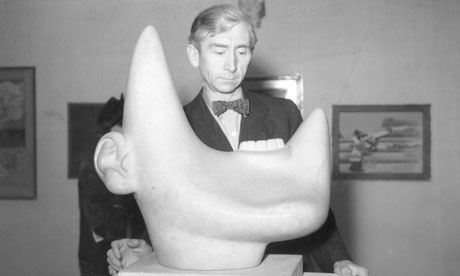
Henry Moore


The business. Besides sounding like a total sweetheart, his works look like Rilke poems feel. They're massive but eloquent; look like what the are and where they came from.


Leonard Baskin


His mention by Read lead me to look him up. I didn't find the sculpture I was looking for, but instead an absolute trove of pen and ink drawings; like if Ralph Steadman, Quentin AND William Blake decided to raise a child together. In the past. And future. Whatever. They're great.


Alberto Giacometti

Poor Albert-o. He had such trouble making what he saw. Lucky for us, though, he didn't throw the lot out like he threatened to. I saw them for the first time in the Tate Modern, I think it was. Big enough to look ungainly but small enough to look you in the eye, you want to wrap a blanket around his figures to keep them warm.

Monday, October 25, 2010

The Elephant House


It would be wrong of me not to include a post about the Elephant House.


We first came here for the same reason that everyone comes here, because it is 'the birthplace of Harry Potter.' We continue to go here, every day for at least 3 hours in my case, for the same reason that Ian Rankin, JK Rowling, and Alexander McCall Smith came here: it magically makes you productive. We don't know whether it's the lighting or the view of the castle.


Maybe it's the huge thick tables or the big windows. Or the sundry stunning teas.

Maybe I don't actually care, so long as they let me nurse my one cup of tea for six hours (which they don't - I occasionally have to resort to a Sprite, the cheapest thing on the menu, to buy more time).

I should explain, because I'm not really this decadent. I am in Scotland where my sister is on a working visa, working. So between accompanying her to job interviews and preparing for Halloween, I have to somehow find time to study for the Guggenheim. The list of book isn't long, but they are good books so it takes me roughly a year to finish each one. Or it would, if it weren't for the Elephant House.


Monday

Tuesday

Wednesday

Thursday

Friday

Saturday

Sunday (new book!)


Thanks, Elephant House. Love your work.


Sunday, October 10, 2010

"Out of Her Mind"

I read about this book before I read this book. Guggenheim's nephew, in a foreword to another Guggenheim tome, sympathised with our poor Peggy when the other more stuffy Guggenheims gave this name (Out Of Her Mind) to her autobiography. I sympathised, too. Darned stuffy Guggenheims, I thought, in not so many thought words. Turns out... they were right.

Not about everything, of course. And perhaps I was misled. Misled by the misleading title - Confessions of an Art Addict. I thought some of it may have been about art. And some of it was about art. Just not enough.

The second chapter, entitled 'Virginity', contains the first mention of 'sex.' I innocently thought it was a bit brave. All I knew of Peggy Guggenheim was that she had moved to Europe and become a bohemian, and was subsequently scorned by her affluent relations. Despite a substantially lesser income, she managed to amass an art collection that surpassed in many ways that of her uncle Solomon and his Baroness. Jackson Pollock emerged fully-formed from her head (read: gallery). She gave one-man shows to anyone she thought deserved them. Heroic. Insightful. Courageous. Independent. As long as she knew how to love she knew she'd stay alive. By the last line of the last chapter, however, I was furious.

How could such an important woman write a text simultaneously so extravagant and banal? Page after page I waited for the "enough about my numerous affairs and schoolgirl crushes, let's talk about the paintings," that would, I eventually found, never come. She had enough bad press (I know, because it's on the reading list) which she complains about. So why, Peggy? Why did you squander your memoirs?
I read on with the same energy that I have powering through gossip magazines at the dentist's because I could never justify buying them. Except this was dirty, dirty gossip about Samuel Beckett. Tanguy.

I was still ranting when I went to a friend's house to watch Walk The Line. There's that scene where that old woman confronts Reese Witherspoon as she's buying fishing tackle and tells her she's a disgrace for getting divorced. I realised I felt a bit like that old woman. It's not that I expected Guggenheim to talk about her faithful relationship to her husband(s). And I wasn't shocked by her 'impropriety' (maybe a bit - the sheer numbers are impressive). But I was surprised by the ratio of art-talk to sex-talk. And I guess that's my fault. In Confessions of an Art Addict I glossed the 'confessions.' Guggenheim was an art addict and she's got some things to confess. There are some parts that are genuinely off-putting (quotes forthcoming). I wanted a treatise on modern art theory, and what I got was the whole rest of this art collector's admittedly thrilling life.

So fair play, Peggy.

I suppose I can just look at the paintings myself, can't I?


Monday, October 4, 2010

Benvenuti

e benvenuto, benvenuto! - a mio umile blog.

That I am still using Google Translate for this sort of thing is a bad sign considering the topic of this blog. The long and short of it? My name is Amy Stewart, and for two months this year I will be working as an intern at the Peggy Guggenheim Collection in Venice, Italy. Here's the long:

I started at the University of Auckland in 2006 intending to study English and Spanish as my sister (Sarah, a.k.a. Sars) had done before me. Fearing inevitable academic humiliation in comparison to this leviathan of wit and insight, I realised I had better pick a different second major. Art of the Twentieth Century in the US and Britain winked at me from the course catalogue and, being a first year and bound to mess a few things up considerably, I gave it a go. And the rest is history!

... Art History, that is. And it's not really, which is why I have to type it all out. Dr. Ed Hanfling took this class, and I can't say whether it was his stunning choice of Fiona Apple's 'Paper Bag' as an opener to the Found Object lecture or the finely orchestrated Dada spectacle involving Dr. Hanfling's own cello prowess and a giant foam kiwi head, but this course managed to separate itself from Cultural Anthropology and the rest of the first-year doldrums (said sister had forbade me from thinking about taking Linguistics). And when Mark Rothko was introduced, well - that changed everything.

It just all made sense. It still does. It never stopped making sense. So I painfully decided I just couldn't give up English and dropped Spanish for Art History. Three years later, Art History juuuuust beat out English for the honour, nay, the privilege, of my BA(Hons) dissertation. That completed, it was time for the OE.

For those of you unfamiliar with the Overseas Experience, permit me to refer you to the Oracle (Wikipedia):

A New Zealand and Australia term for an extended overseas working holiday. Sometimes referred to as "The big OE" in reference to the extended duration of the travel - typically at least one year, and often extending far longer. It is believed to have been coined by New Zealand cartoonist and columnist Tom Scott. [...] This period of overseas travel plays an important part in the lives of many by broadening their experience in life - especially important for relatively isolated countries such as New Zealand and Australia.

This is precisely what I have been up to during 2010, and brings us pretty well up to date. For more witty and insightful detail on this spiritual post-degree journey, I refer you to the sister blog of this one which is written primarily by my... sister. I managed alright this year despite the difficulties of handling money and suitcases, not to mention driving, with my fingers crossed wishin' and a-hopin' and a-thinkin' about the elusive Guggenheim internship.

I was eventually put out of my misery (in the best possible way) and am now in Edinburgh, where I am living for the time being, preparing.


I must say, it's a pretty rad place to prepare for anything, really.